

Frequently asked questions
Does it need a WiFi connection?
No. The ModuleAir keeps measuring without internet access and shows live values on its LED display. It has no local data storage, however, so the measurement history requires a WiFi connection to send data to the AirCarto servers.
Which WiFi networks are supported?
2.4 GHz networks protected by a password (WPA/WPA2), or open networks. Not supported:
- 5 GHz networks
- Networks with a captive portal or a username and password login, as found in universities, hotels and some offices
How is the CO2 sensor calibrated?
The Senseair S88 uses automatic baseline calibration (ABC), which aligns its baseline with the lowest value seen over a rolling period (8 days by default), so it needs no maintenance as long as the room is aired from time to time. The circuit board also has a manual calibration button.
How has the particle sensor been evaluated?
The NextPM has been tested in the field and in the laboratory by AQ-SPEC, the sensor testing programme of the South Coast Air Quality Management District (California). The reports are listed in the AQ-SPEC summary table.
What is open source?
The firmware is open source and published on GitHub. The enclosure is 3D-printable, and the STL file, technical drawings, schematic and pinout are on the AirCarto wiki (in French), so the sensor can be repaired and modified.
ModuleAir WiFi
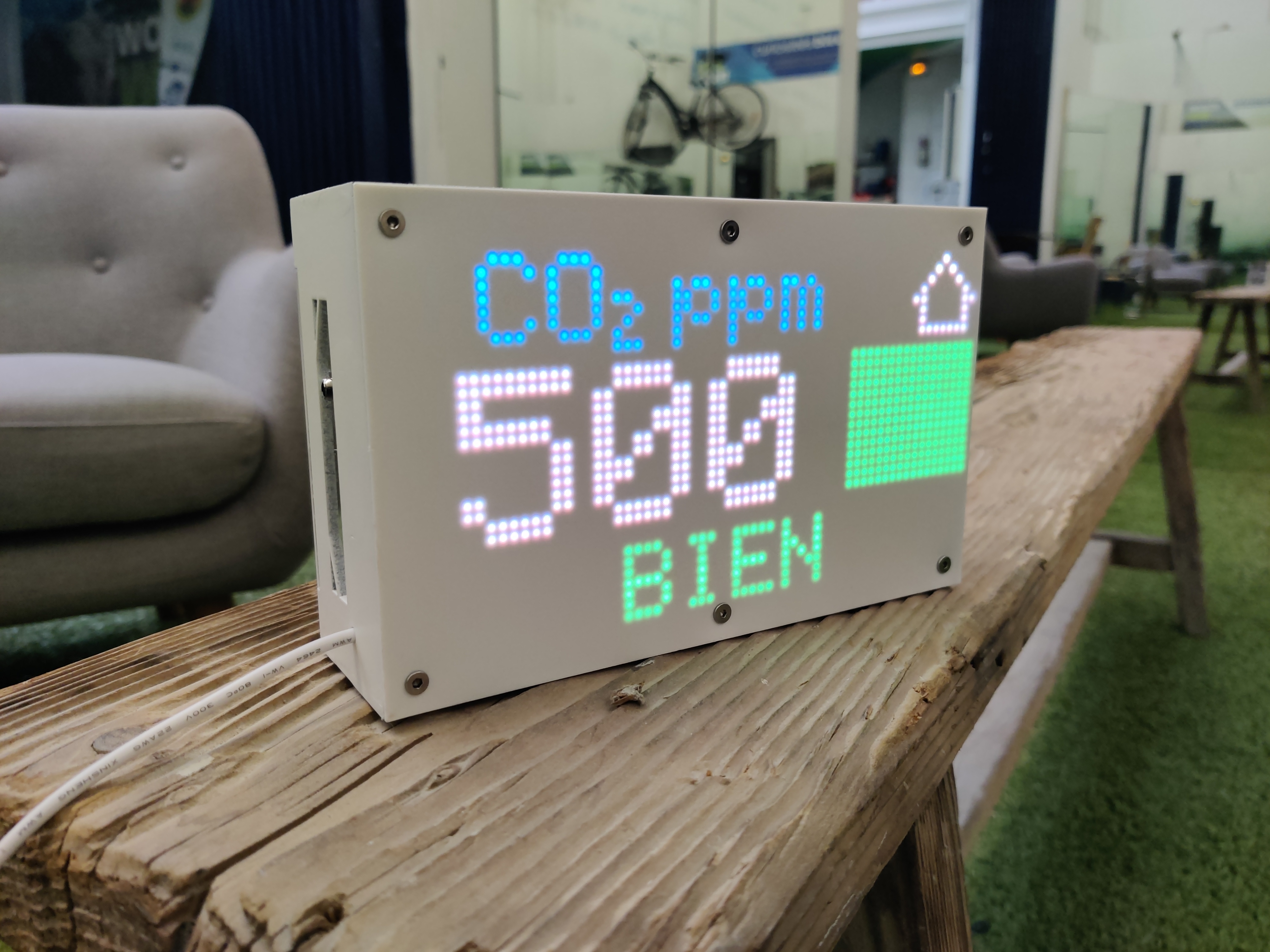
A wall-mounted indoor monitor for CO2 and fine particulate matter, with a large LED display for classrooms, offices and other rooms open to the public.
The ModuleAir measures CO2 and PM1, PM2.5 and PM10 continuously. Its LED matrix cycles through the pollutants, one every 5 seconds, with a colour code showing the air quality level. For CO2 the default thresholds are 800 and 1500 ppm; both can be changed from the sensor's web dashboard.
Connected to a 2.4 GHz WiFi network, it sends its readings to the AirCarto servers
every 60 seconds. You can then follow them as charts on
moduleair.fr. On the local network,
the dashboard at http://moduleair.local shows the latest readings and
settings, and /data.json exposes them for Home Assistant without going
through the cloud (firmware 0.4.0 or later). Firmware updates are done over the air
from the dashboard.
Setup takes place from a phone or computer with no app to install: the sensor opens its own WiFi access point and a configuration page, where you pick your network. It can also be set up over Bluetooth (Improv standard) from Chrome or Edge.
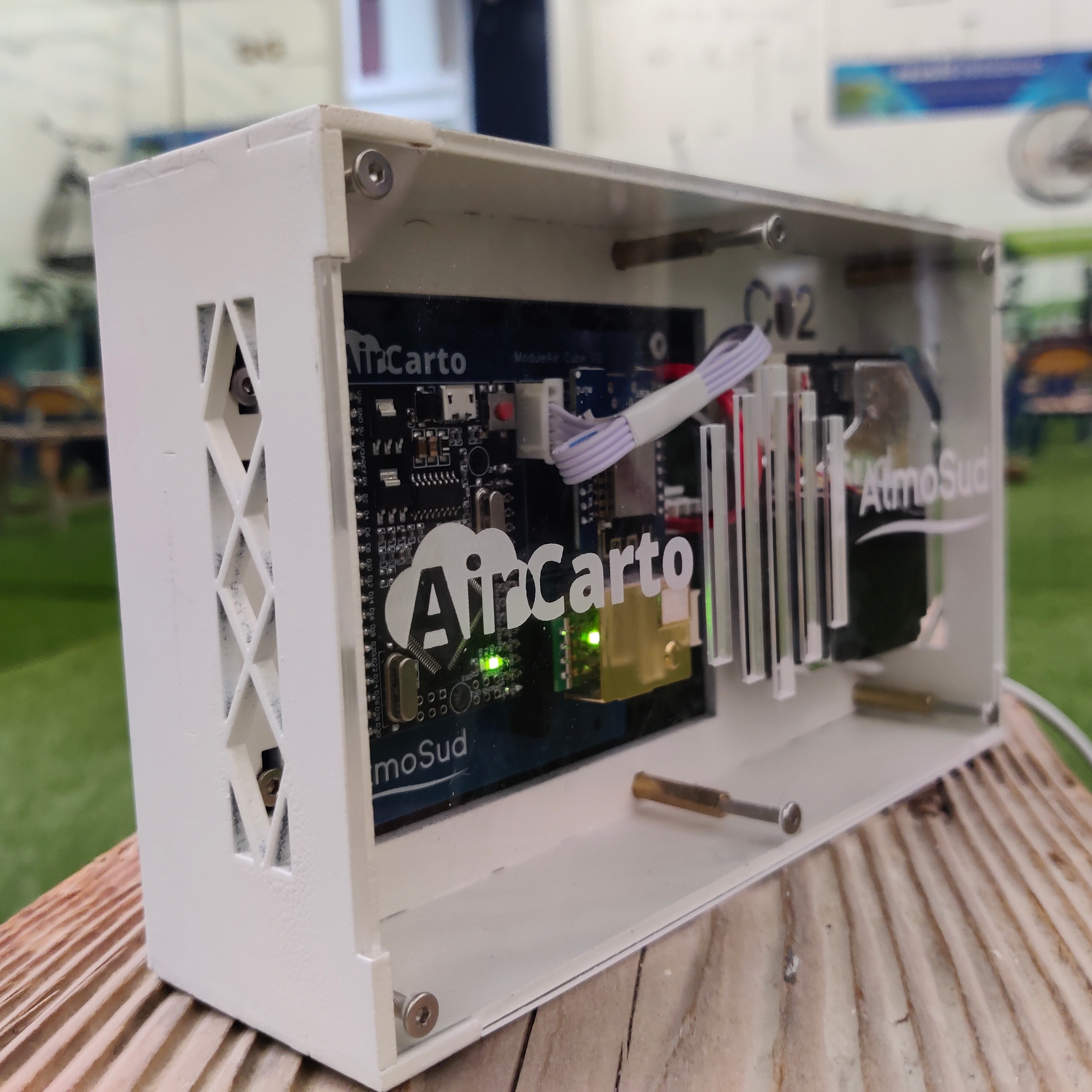
The particle sensor is the NextPM, made in France by Tera Sensor, also used in the NebuleAir Pro. Its laser counts particles from 0.3 to 10 µm, reading the scattered light at two angles, and a built-in heater keeps internal humidity below 60 % so that readings remain valid in humid air.
Technical specifications (version 4)
- CO2 sensor: Senseair S88, NDIR, 400 to 10,000 ppm, ± 40 ppm ± 3 % of reading (units built before September 2026 use a Winsen MH-Z19C, 400 to 5,000 ppm)
- Particle sensor: NextPM (Tera Sensor), PM1, PM2.5 and PM10 in µg/m³
- Option: CCS811 probe for total volatile organic compounds, 0 to 1,187 ppb, intended for following trends rather than absolute values
- Option, on request: remote BME280 probe for temperature, humidity and pressure, placed outside the enclosure to avoid heat from the display
- Display: 64 × 32 RGB LED matrix (HUB75), in two sizes: 160 × 80 mm (P2.5) or 192 × 96 mm (P3), adjustable brightness
- Controller: ESP32-WROOM-32U, WiFi 802.11 b/g/n, 2.4 GHz, external antenna
- Power: USB 5 V (a standard 5 V / 1 A adapter is sufficient), about 0.86 W on average and 2.56 W at peak, or about 7.5 kWh per year
- Size with P2.5 matrix: 159.9 × 79.2 × 45.9 mm, excluding cable
- 3D-printed enclosure with air vents for the sensors
Price on request. Tell us the quantity and where the sensors will be installed.
ModuleAir Mini: the desktop version
The ModuleAir Mini sits on a desk or table. A tilted enclosure carries a 4.3-inch colour touchscreen used both for display and for setup. It also measures temperature and humidity, and logs readings to a memory card, so it can run with or without a network connection.
| ModuleAir WiFi | ModuleAir Mini | |
|---|---|---|
| Display | 64 × 32 LED matrix | 4.3-inch colour touchscreen, 480 × 272 |
| Measurements | PM1, PM2.5, PM10, CO2 | PM1, PM2.5, PM10, CO2, temperature, humidity |
| WiFi setup | Captive portal or Bluetooth | Bluetooth (Cyan Sensor app) or on-screen keyboard |
| Local storage | None | microSD card (CSV log) |
| Power | USB 5 V | USB-C 5 V, or 18650 Li-ion battery (3,200 mAh) |
| Data retrieval | WiFi | USB-C, Bluetooth (Cyan Sensor app) or WiFi |
| Typical use | Wall-mounted, classrooms, rooms open to the public | Desk, table, workstation |
The Mini uses the same NextPM and Senseair S88 sensors, with a BME280 on board and an ESP32-S3 controller. On battery it runs for about 7 hours at full screen brightness and about 13 hours at minimum brightness. The full documentation is on the AirCarto wiki (in French).
Request a quote for the Mini